




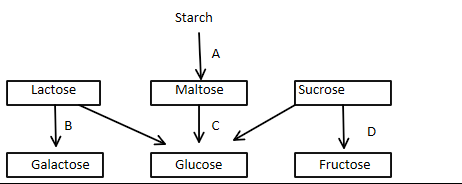
The following is a scheme showing the fate of carbohydrates during the digestion in the human alimentary canal. Identify the enzyme acting at stages indicated as A, B, C and D. Choose the correct option from those given.
A. A-amylase, B-maltase, C-lactase, D-invertase.
B. A-amylase, B-maltase, C-invertase, D-lactase.
C. A-amylase, B-invertase, C-maltase, D-lactase.
D. A-amylase, B-lactase, C-maltase, D-invertase.
Answer
 Verified
573.9k+ views
Hint:-Enzymes are defined as the proteins that behave as biological catalysts. Catalysts are those which enhance the rate of chemical reactions which itself is changed. The alimentary canal is simply a pathway through which food enters into the body and excretes out with the help of anus after the process of digestion.
Complete Answer:-
An enzyme used for the hydrolysis of starch to convert it into sugars like maltose, lactose, sucrose etc. is known as amylase. This enzyme helps to start the process of chemical digestion because it is existing in the saliva of humans and some other mammals. Lactase is an enzyme that converts lactose (a type of sugar which is present in milk and gives it sweetness). This enzyme is elicited by the various organisms. It is found in the small intestine (brush border portion) of humans and distinct mammals. Lactase is important for the complete digestion of entire milk. Invertase is an enzyme that causes the breakdown of sucrose. Maltase is an enzyme that catalyses the conversion of maltose into the simple sugar i.e. glucose. This enzyme is located on the brush border of the small intestine that catalyses the breakdown of disaccharide maltose.
Thus, the right option is D.
Note:- The substrate is defined as the molecules upon which enzymes work and enzymes convert the substrate into the product. The alimentary canal is a long tube about 9 meter that runs from mouth to anus and includes- the oesophagus, stomach, small intestine and large intestine. Digestion that starts in the mouth, well before food enters into the stomach.
Complete Answer:-
An enzyme used for the hydrolysis of starch to convert it into sugars like maltose, lactose, sucrose etc. is known as amylase. This enzyme helps to start the process of chemical digestion because it is existing in the saliva of humans and some other mammals. Lactase is an enzyme that converts lactose (a type of sugar which is present in milk and gives it sweetness). This enzyme is elicited by the various organisms. It is found in the small intestine (brush border portion) of humans and distinct mammals. Lactase is important for the complete digestion of entire milk. Invertase is an enzyme that causes the breakdown of sucrose. Maltase is an enzyme that catalyses the conversion of maltose into the simple sugar i.e. glucose. This enzyme is located on the brush border of the small intestine that catalyses the breakdown of disaccharide maltose.
Thus, the right option is D.
Note:- The substrate is defined as the molecules upon which enzymes work and enzymes convert the substrate into the product. The alimentary canal is a long tube about 9 meter that runs from mouth to anus and includes- the oesophagus, stomach, small intestine and large intestine. Digestion that starts in the mouth, well before food enters into the stomach.
Recently Updated Pages
Master Class 12 Economics: Engaging Questions & Answers for Success

Master Class 12 Physics: Engaging Questions & Answers for Success
Master Class 12 English: Engaging Questions & Answers for Success
Master Class 12 Social Science: Engaging Questions & Answers for Success
Master Class 12 Maths: Engaging Questions & Answers for Success
Master Class 12 Business Studies: Engaging Questions & Answers for Success
Trending doubts
Which are the Top 10 Largest Countries of the World?
What are the major means of transport Explain each class 12 social science CBSE
Draw a labelled sketch of the human eye class 12 physics CBSE
What is a transformer Explain the principle construction class 12 physics CBSE
Why cannot DNA pass through cell membranes class 12 biology CBSE
Differentiate between insitu conservation and exsitu class 12 biology CBSE