




The total number of vertebrae in man is
(a)30
(b)31
(c)32
(d)33
Answer
 Verified
587.7k+ views
Hint: The prime factor of the number of vertebrates in man is equal to $3 \times 11$. This is a unique number as the product of this number is a product of two prime numbers.
Complete answer:
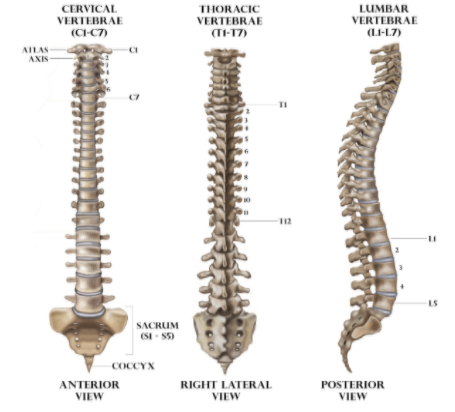
The vertebral column of man has 33 vertebrae. Each vertebra is named according to their position and location. There are 7 cervical spines, 12 thoracic spines, 5 lumbar spines, 5 fused sacrum spine, and 4 coccyx. 7 cervical, 12 thoracic, and 5 lumbar are the presacral vertebrae.
The 24 presacral vertebrae will help in the movement and, thus, provides the flexibility to the vertebral column. Ligaments, muscles, and bones provide stability.
Curvature:
The adult vertebral column has four anteroposterior curvatures. The thoracic and sacral, both are concave anteriorly and cervical and lumbar, both are concave posteriorly. The thoracic and sacral curvatures are called primary, which appears during the embryonic period whereas the cervical and lumbar curvatures, called secondary, appear later (before birth) and accentuate in infancy by the support of the head and by the adoption of an upright posture.
The image of the vertebrae is given in the below figure.
So, the correct answer is’33’.
Note: The vertebral column's main function is to protect the spinal cord; it also provides body stiffening and attachment for pectoral and pelvic girdles and many muscles. An additional function in humans is the transmission of body weight while walking and standing.
Complete answer:
The vertebral column of man has 33 vertebrae. Each vertebra is named according to their position and location. There are 7 cervical spines, 12 thoracic spines, 5 lumbar spines, 5 fused sacrum spine, and 4 coccyx. 7 cervical, 12 thoracic, and 5 lumbar are the presacral vertebrae.
The 24 presacral vertebrae will help in the movement and, thus, provides the flexibility to the vertebral column. Ligaments, muscles, and bones provide stability.
Curvature:
The adult vertebral column has four anteroposterior curvatures. The thoracic and sacral, both are concave anteriorly and cervical and lumbar, both are concave posteriorly. The thoracic and sacral curvatures are called primary, which appears during the embryonic period whereas the cervical and lumbar curvatures, called secondary, appear later (before birth) and accentuate in infancy by the support of the head and by the adoption of an upright posture.
The image of the vertebrae is given in the below figure.
So, the correct answer is’33’.
Note: The vertebral column's main function is to protect the spinal cord; it also provides body stiffening and attachment for pectoral and pelvic girdles and many muscles. An additional function in humans is the transmission of body weight while walking and standing.
Recently Updated Pages
Master Class 12 Economics: Engaging Questions & Answers for Success

Master Class 12 Physics: Engaging Questions & Answers for Success
Master Class 12 English: Engaging Questions & Answers for Success
Master Class 12 Social Science: Engaging Questions & Answers for Success
Master Class 12 Maths: Engaging Questions & Answers for Success
Master Class 12 Business Studies: Engaging Questions & Answers for Success
Trending doubts
Which are the Top 10 Largest Countries of the World?
What are the major means of transport Explain each class 12 social science CBSE
Draw a labelled sketch of the human eye class 12 physics CBSE
What is a transformer Explain the principle construction class 12 physics CBSE
Why cannot DNA pass through cell membranes class 12 biology CBSE
Differentiate between insitu conservation and exsitu class 12 biology CBSE