




The type of sex determination in honey bee is
a. Diploidy
b. Haplo-diploidy
c. ZZ – ZW
d. Haploidy
Answer
 Verified
567.6k+ views
Hint: The sex determination is the method to find whether the organism is male or female. It can be done by finding the number of chromosomes or type of chromosomes present in the organisms. The organisms which contain complete sets of chromosomes are diploid while the haploid organisms contain half the number of chromosomes.
Complete answer:
The sex determination in the honey bees is mainly understood by the fertilization and non-fertilization of eggs. Johann Dzierzon in 1845 discovered this type of the sex determination.
In Haplo-diploid system, the male progeny develops from the unfertilized eggs. The eggs are haploid and carry only one set of the chromosomes. These are known as drones or male honey bees. The queens and worker bees develop from the fertilized honey bee eggs, which have two sets of chromosomes and act as diploid eggs.
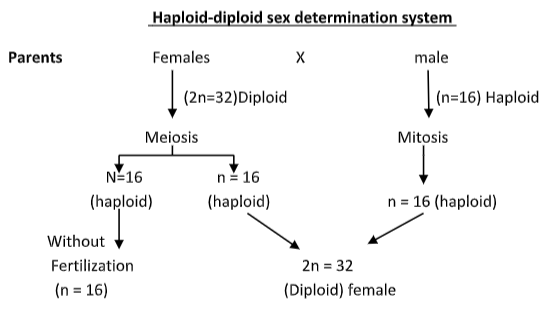
This type of Haplo-diploid sex determination can be observed in honeybees.
The ZZ and ZW type of sex determination occurs in the birds in which females are heterozygous (ZW) and males are homozygous (ZZ).
Hence, the correct answer is option (B).
Note: The complementary sex determination theory explains that male honey bees can be diploid as the result of inbreeding. Fertile males can be produced from the queen’s unfertilized, haploid eggs which are hemizygous. In humans, the sex determination is mainly based of the presence of X and Y and chromosomes. Males are heterozygous in humans (XY) while females are homozygous (XX).
Complete answer:
The sex determination in the honey bees is mainly understood by the fertilization and non-fertilization of eggs. Johann Dzierzon in 1845 discovered this type of the sex determination.
In Haplo-diploid system, the male progeny develops from the unfertilized eggs. The eggs are haploid and carry only one set of the chromosomes. These are known as drones or male honey bees. The queens and worker bees develop from the fertilized honey bee eggs, which have two sets of chromosomes and act as diploid eggs.
This type of Haplo-diploid sex determination can be observed in honeybees.
The ZZ and ZW type of sex determination occurs in the birds in which females are heterozygous (ZW) and males are homozygous (ZZ).
Hence, the correct answer is option (B).
Note: The complementary sex determination theory explains that male honey bees can be diploid as the result of inbreeding. Fertile males can be produced from the queen’s unfertilized, haploid eggs which are hemizygous. In humans, the sex determination is mainly based of the presence of X and Y and chromosomes. Males are heterozygous in humans (XY) while females are homozygous (XX).
Recently Updated Pages
Master Class 12 Economics: Engaging Questions & Answers for Success

Master Class 12 Physics: Engaging Questions & Answers for Success
Master Class 12 English: Engaging Questions & Answers for Success
Master Class 12 Social Science: Engaging Questions & Answers for Success
Master Class 12 Maths: Engaging Questions & Answers for Success
Master Class 12 Business Studies: Engaging Questions & Answers for Success
Trending doubts
Which are the Top 10 Largest Countries of the World?
What are the major means of transport Explain each class 12 social science CBSE
Draw a labelled sketch of the human eye class 12 physics CBSE
What is a transformer Explain the principle construction class 12 physics CBSE
Why cannot DNA pass through cell membranes class 12 biology CBSE
Differentiate between insitu conservation and exsitu class 12 biology CBSE