




Two polaroids are kept crossed to each other. If one of them is rotated an angle ${{60}^{0}}$ , the percentage of incident light now transmitted through the system is
(A) 10%
(B) 20%
(C) 25%
(D) 12.5%
Answer
 Verified
552.9k+ views
Hint: When unpolarized light is passed through a polaroid, light becomes linearly polarized. The transmitted intensity is proportional to the square of the amplitude (square of the cosine of the angle between the two polaroids), this is called Law of Malus.
Complete answer:
A polaroid is a synthetic material made of crystals of a dichroic substance which are oriented parallel to each other so as to transmit light only in a particular direction that produces plane polarized light when light is passed through it.
According to the question, let us consider, two polaroids that are kept crossed to each other and one of them is rotated at an angle ${{60}^{0}}$, as shown in the figure below,
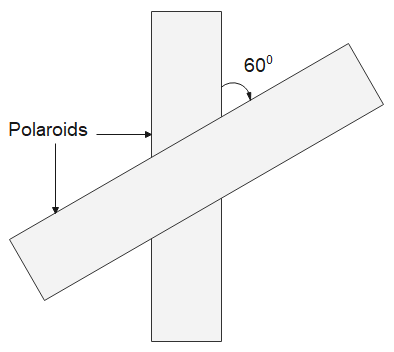
Let the intensity of the unpolarized light incident on the polaroid be ${{I}_{0}}$.
When unpolarized light is passed through the first polaroid, it becomes linearly polarized and now the intensity of the plane polarized light is equal to,
${{I}_{1}}=\dfrac{{{I}_{0}}}{2}$ ….(i)
Then, the second Polaroid is rotated at an angle ${{60}^{0}}$, the intensity of the light from this polaroid is given by the Law of Malus, given by,
$I={{I}_{0}}{{\cos }^{2}}\theta $
Hence, applying the above formula in our case we get,
${{I}_{2}}={{I}_{1}}{{\cos }^{2}}\theta =\dfrac{{{I}_{0}}}{2}{{(\cos 60)}^{2}}=\dfrac{{{I}_{0}}}{2}\times \dfrac{1}{{{2}^{2}}}=\dfrac{{{I}_{0}}}{8}=0.125{{I}_{0}}$ ….(ii) [since, $\theta ={{60}^{0}}$]
Therefore, the percentage of incident light now transmitted through these two polaroids is,
Percentage=$0.125\times 100=12.5%$
Thus, the correct answer is option (D).
Note:
It is important for students to remember the Law of Malus and how it is applied as well as the formula used. If the two polaroids are at right angles to each other, then cosine term becomes zero, that is no light passes through the arrangement (transmitted intensity is zero).
Complete answer:
A polaroid is a synthetic material made of crystals of a dichroic substance which are oriented parallel to each other so as to transmit light only in a particular direction that produces plane polarized light when light is passed through it.
According to the question, let us consider, two polaroids that are kept crossed to each other and one of them is rotated at an angle ${{60}^{0}}$, as shown in the figure below,
Let the intensity of the unpolarized light incident on the polaroid be ${{I}_{0}}$.
When unpolarized light is passed through the first polaroid, it becomes linearly polarized and now the intensity of the plane polarized light is equal to,
${{I}_{1}}=\dfrac{{{I}_{0}}}{2}$ ….(i)
Then, the second Polaroid is rotated at an angle ${{60}^{0}}$, the intensity of the light from this polaroid is given by the Law of Malus, given by,
$I={{I}_{0}}{{\cos }^{2}}\theta $
Hence, applying the above formula in our case we get,
${{I}_{2}}={{I}_{1}}{{\cos }^{2}}\theta =\dfrac{{{I}_{0}}}{2}{{(\cos 60)}^{2}}=\dfrac{{{I}_{0}}}{2}\times \dfrac{1}{{{2}^{2}}}=\dfrac{{{I}_{0}}}{8}=0.125{{I}_{0}}$ ….(ii) [since, $\theta ={{60}^{0}}$]
Therefore, the percentage of incident light now transmitted through these two polaroids is,
Percentage=$0.125\times 100=12.5%$
Thus, the correct answer is option (D).
Note:
It is important for students to remember the Law of Malus and how it is applied as well as the formula used. If the two polaroids are at right angles to each other, then cosine term becomes zero, that is no light passes through the arrangement (transmitted intensity is zero).
Recently Updated Pages
Master Class 12 Economics: Engaging Questions & Answers for Success

Master Class 12 Physics: Engaging Questions & Answers for Success
Master Class 12 English: Engaging Questions & Answers for Success
Master Class 12 Social Science: Engaging Questions & Answers for Success
Master Class 12 Maths: Engaging Questions & Answers for Success
Master Class 12 Business Studies: Engaging Questions & Answers for Success
Trending doubts
Which are the Top 10 Largest Countries of the World?
What are the major means of transport Explain each class 12 social science CBSE
Draw a labelled sketch of the human eye class 12 physics CBSE
Why cannot DNA pass through cell membranes class 12 biology CBSE
Differentiate between insitu conservation and exsitu class 12 biology CBSE
Draw a neat and well labeled diagram of TS of ovary class 12 biology CBSE