



Which amongst the following metal carbonyls are inner orbital complexes with diamagnetic property?
(i) $ Ni{(CO)_4} $
(ii) $ Fe{(CO)_5} $
(iii) $ V{(CO)_6} $
(iv) $ Cr{(CO)_6} $
Select the correct answer from the codes given below:
(A) I and II only
(B) II, III and IV only
(C) II and IV only
(D) I and II only
Answer
 Verified
514.2k+ views
Hint :The coordination compounds in which the hybridization state of the central metal includes d orbitals from inner shell while s and p orbitals from outer shell are known as inner orbital complexes. These are also known as low spin complexes and observed only if the ligand bonded to the central metal atom is a strong field ligand.
Complete Step By Step Answer:
To check the magnetic properties and the type of complexes, we need to write the electronic configuration for each central metal given in the compounds. The electronic configuration for given complexes is as follows:
$ Ni{(CO)_4} $ :
The ground state electronic configuration of nickel $ = 3{d^8}4{s^2} $
As $ CO $ is the strong field ligand, so all the ten electrons paired up in d orbital leaving s and p orbitals vacant. Then, the $ 4s $ and $ 4p $ orbitals participate in the bonding with $ CO $ to give $ Ni{(CO)_4} $ . The hybridization state of nickel is $ s{p^3} $ and it has a tetrahedral structure.
The formation of bonds in $ Ni{(CO)_4} $ is explained as follows:
Electronic configuration of nickel at ground state:
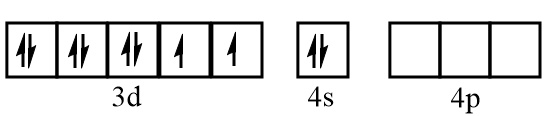
Electronic configuration of nickel when $ CO $ molecules approach toward it:
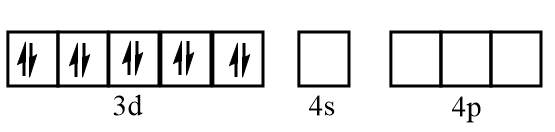
Electronic configuration of nickel after formation of $ Ni{(CO)_4} $ complex:
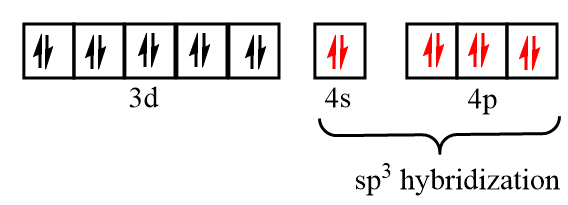
As there is no unpaired electron present in the orbitals, so $ Ni{(CO)_4} $ is diamagnetic in nature and because no inner d orbital participates in the hybridization of the complex, so it is not considered as an inner orbital complex.
$ Fe{(CO)_5} $ :
The ground state electronic configuration of iron $ = 3{d^6}4{s^2} $
As $ CO $ is the strong field ligand, so all pairing of electrons takes place in the d-orbital due to which the hybridization state of the iron after formation of complex becomes $ ds{p^3} $ .
The formation of bonds in $ Fe{(CO)_5} $ is explained as follows:
Electronic configuration of iron at ground state:
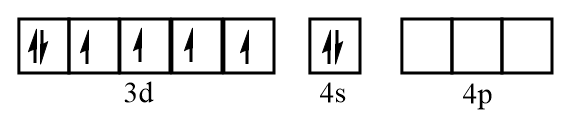
Electronic configuration of iron when $ CO $ molecules approach toward it:

Electronic configuration of iron after formation of $ Fe{(CO)_5} $ complex:
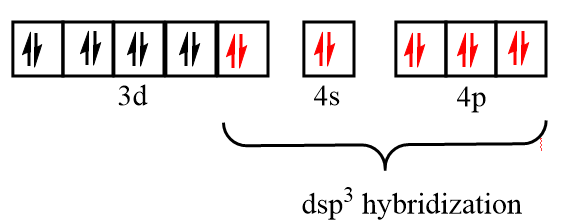
As there is no unpaired electron present in the orbitals, so $ Fe{(CO)_5} $ is diamagnetic in nature and due to participation of the inner d orbital in hybridization, it is known as the inner orbital complex.
$ V{(CO)_6} $ :
The ground state electronic configuration of vanadium $ = 3{d^3}4{s^2} $
As $ CO $ is the strong field ligand, so all pairing of electrons takes place in the d-orbital due to which the hybridization state of the vanadium after formation of complex becomes $ {d^2}s{p^3} $ .
The formation of bonds in $ V{(CO)_6} $ is explained as follows:
Electronic configuration of vanadium at ground state:

Electronic configuration of vanadium when $ CO $ molecules approach toward it:
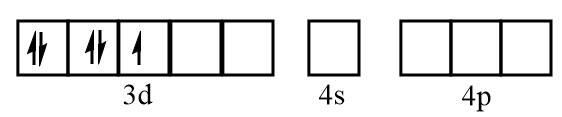
Electronic configuration of vanadium after formation of $ V{(CO)_6} $ complex:
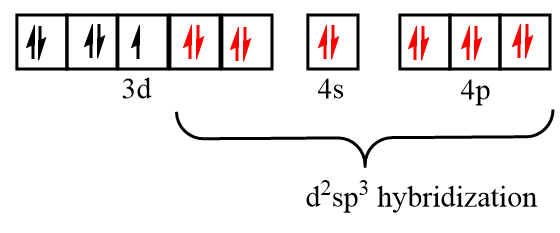
As there is one unpaired electron present in the orbitals, so $ V{(CO)_6} $ is paramagnetic in nature and due to participation of the inner d orbital in hybridization, it is known as the inner orbital complex.
$ Cr{(CO)_6} $ :
The ground state electronic configuration of chromium $ = 3{d^5}4{s^1} $
As $ CO $ is the strong field ligand, so all pairing of electrons takes place in the d-orbital due to which the hybridization state of the chromium after formation of complex becomes $ {d^2}s{p^3} $ .
The formation of bonds in $ Cr{(CO)_6} $ is explained as follows:
Electronic configuration of chromium at ground state:

Electronic configuration of chromium when $ CO $ molecules approach toward it:
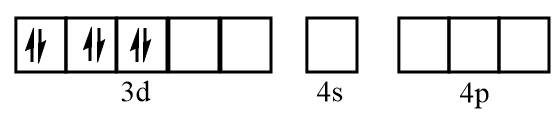
Electronic configuration of chromium after formation of $ Cr{(CO)_6} $ complex:
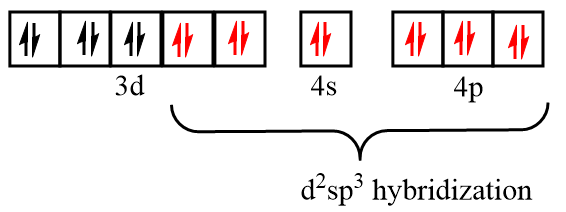
As there is no unpaired electron present in the orbitals, so $ Cr{(CO)_6} $ is diamagnetic in nature and due to participation of the inner d orbital in hybridization, it is known as the inner orbital complex.
Hence, only II and IV compounds are inner orbital complexes with diamagnetic properties. So, option (C) is the correct answer.
Note :
It is important to note that the compounds in which are bonded with weak field ligands and the outer d orbitals participate in the hybridization, that compound is known as outer orbital complex or high spin complex. Pairing of electrons does not take place in such complexes.
Complete Step By Step Answer:
To check the magnetic properties and the type of complexes, we need to write the electronic configuration for each central metal given in the compounds. The electronic configuration for given complexes is as follows:
$ Ni{(CO)_4} $ :
The ground state electronic configuration of nickel $ = 3{d^8}4{s^2} $
As $ CO $ is the strong field ligand, so all the ten electrons paired up in d orbital leaving s and p orbitals vacant. Then, the $ 4s $ and $ 4p $ orbitals participate in the bonding with $ CO $ to give $ Ni{(CO)_4} $ . The hybridization state of nickel is $ s{p^3} $ and it has a tetrahedral structure.
The formation of bonds in $ Ni{(CO)_4} $ is explained as follows:
Electronic configuration of nickel at ground state:
Electronic configuration of nickel when $ CO $ molecules approach toward it:
Electronic configuration of nickel after formation of $ Ni{(CO)_4} $ complex:
As there is no unpaired electron present in the orbitals, so $ Ni{(CO)_4} $ is diamagnetic in nature and because no inner d orbital participates in the hybridization of the complex, so it is not considered as an inner orbital complex.
$ Fe{(CO)_5} $ :
The ground state electronic configuration of iron $ = 3{d^6}4{s^2} $
As $ CO $ is the strong field ligand, so all pairing of electrons takes place in the d-orbital due to which the hybridization state of the iron after formation of complex becomes $ ds{p^3} $ .
The formation of bonds in $ Fe{(CO)_5} $ is explained as follows:
Electronic configuration of iron at ground state:
Electronic configuration of iron when $ CO $ molecules approach toward it:
Electronic configuration of iron after formation of $ Fe{(CO)_5} $ complex:
As there is no unpaired electron present in the orbitals, so $ Fe{(CO)_5} $ is diamagnetic in nature and due to participation of the inner d orbital in hybridization, it is known as the inner orbital complex.
$ V{(CO)_6} $ :
The ground state electronic configuration of vanadium $ = 3{d^3}4{s^2} $
As $ CO $ is the strong field ligand, so all pairing of electrons takes place in the d-orbital due to which the hybridization state of the vanadium after formation of complex becomes $ {d^2}s{p^3} $ .
The formation of bonds in $ V{(CO)_6} $ is explained as follows:
Electronic configuration of vanadium at ground state:
Electronic configuration of vanadium when $ CO $ molecules approach toward it:
Electronic configuration of vanadium after formation of $ V{(CO)_6} $ complex:
As there is one unpaired electron present in the orbitals, so $ V{(CO)_6} $ is paramagnetic in nature and due to participation of the inner d orbital in hybridization, it is known as the inner orbital complex.
$ Cr{(CO)_6} $ :
The ground state electronic configuration of chromium $ = 3{d^5}4{s^1} $
As $ CO $ is the strong field ligand, so all pairing of electrons takes place in the d-orbital due to which the hybridization state of the chromium after formation of complex becomes $ {d^2}s{p^3} $ .
The formation of bonds in $ Cr{(CO)_6} $ is explained as follows:
Electronic configuration of chromium at ground state:
Electronic configuration of chromium when $ CO $ molecules approach toward it:
Electronic configuration of chromium after formation of $ Cr{(CO)_6} $ complex:
As there is no unpaired electron present in the orbitals, so $ Cr{(CO)_6} $ is diamagnetic in nature and due to participation of the inner d orbital in hybridization, it is known as the inner orbital complex.
Hence, only II and IV compounds are inner orbital complexes with diamagnetic properties. So, option (C) is the correct answer.
Note :
It is important to note that the compounds in which are bonded with weak field ligands and the outer d orbitals participate in the hybridization, that compound is known as outer orbital complex or high spin complex. Pairing of electrons does not take place in such complexes.
Recently Updated Pages
Master Class 12 Economics: Engaging Questions & Answers for Success

Master Class 12 Physics: Engaging Questions & Answers for Success
Master Class 12 English: Engaging Questions & Answers for Success
Master Class 12 Social Science: Engaging Questions & Answers for Success
Master Class 12 Maths: Engaging Questions & Answers for Success
Master Class 12 Business Studies: Engaging Questions & Answers for Success
Trending doubts
Which are the Top 10 Largest Countries of the World?
What are the major means of transport Explain each class 12 social science CBSE
Draw a labelled sketch of the human eye class 12 physics CBSE
What is a transformer Explain the principle construction class 12 physics CBSE
Why cannot DNA pass through cell membranes class 12 biology CBSE
Differentiate between insitu conservation and exsitu class 12 biology CBSE