




Which of the following is true for the uniform electric field?
A) All the points are at the same potential.
B) No two points can have the same potential.
C) Pairs of points separated by the different distance must have the same difference in potential.
D) None of these
Answer
 Verified
577.8k+ views
Hint: We are to analyse the different aspects of the electric field with respect to the electric potential. We can do this by finding an appropriate relation between them and thereby producing desirable connections between the two quantities.
Complete step by step answer:
The electric field is a vector quantity which denotes the direction in which a positive charge tends to move when brought near to another positive charge. It is the force offered by a charge on another charge over a distance. Every charge has its own electric field, a positive charge has an electric field coming from it and radiated outwards. The direction of the electric field is from positive to negative.
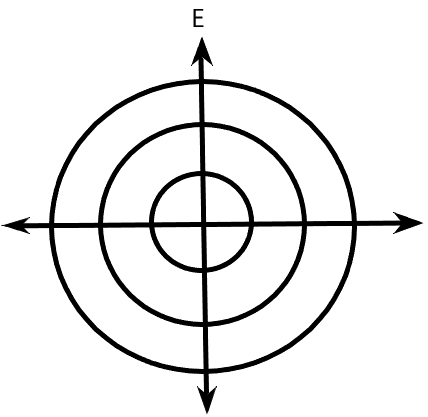
We can see from the above figure, a positive charge placed at the center produces an electric in all directions radially outwards. The circles denote the equipotential surface, i.e., the surfaces in which the potentials are constant. From this we can understand that more than two points can have the same potential when in an electric field. But all the points do not have an equal potential also.
Now, if we look at the different equipotential surfaces, we can understand that the difference of electrical field between two equipotential surfaces will not be constant, it is given by the relation between the electric field and electric potential –
\[E=\dfrac{V}{r}\]
Where, r is the distance between the charges.
So, the correct answer is “Option D”.
Note: The electric potential energy is the work done in bringing a charge from infinity to another charge against the electric field produced by the static charge. The electric potential is the potential of a charge to do a work on another charge moving against its electric field.
Complete step by step answer:
The electric field is a vector quantity which denotes the direction in which a positive charge tends to move when brought near to another positive charge. It is the force offered by a charge on another charge over a distance. Every charge has its own electric field, a positive charge has an electric field coming from it and radiated outwards. The direction of the electric field is from positive to negative.
We can see from the above figure, a positive charge placed at the center produces an electric in all directions radially outwards. The circles denote the equipotential surface, i.e., the surfaces in which the potentials are constant. From this we can understand that more than two points can have the same potential when in an electric field. But all the points do not have an equal potential also.
Now, if we look at the different equipotential surfaces, we can understand that the difference of electrical field between two equipotential surfaces will not be constant, it is given by the relation between the electric field and electric potential –
\[E=\dfrac{V}{r}\]
Where, r is the distance between the charges.
So, the correct answer is “Option D”.
Note: The electric potential energy is the work done in bringing a charge from infinity to another charge against the electric field produced by the static charge. The electric potential is the potential of a charge to do a work on another charge moving against its electric field.
Recently Updated Pages
Master Class 12 Economics: Engaging Questions & Answers for Success

Master Class 12 Physics: Engaging Questions & Answers for Success
Master Class 12 English: Engaging Questions & Answers for Success
Master Class 12 Social Science: Engaging Questions & Answers for Success
Master Class 12 Maths: Engaging Questions & Answers for Success
Master Class 12 Business Studies: Engaging Questions & Answers for Success
Trending doubts
Which are the Top 10 Largest Countries of the World?
What are the major means of transport Explain each class 12 social science CBSE
Draw a labelled sketch of the human eye class 12 physics CBSE
What is a transformer Explain the principle construction class 12 physics CBSE
Why cannot DNA pass through cell membranes class 12 biology CBSE
Differentiate between insitu conservation and exsitu class 12 biology CBSE