




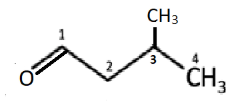
Write the structure of 3-methylbutanal.
Answer
 Verified
585.6k+ views
Hint: The important point one should take care about while writing the structures of any compound is the root word. The root word gives the longest carbon chain and then attach the substituents as per the positions given in the IUPAC name.
Complete step by step answer:
-According to IUPAC nomenclature, if organic compounds contain one principal functional group then the longest continuous chain of carbon atoms having the principal functional group is selected. In organic chemistry, functional groups are specific substituents in the molecules which are responsible for the characteristic chemical reactions of those molecules.
-The word root for the given compound is butane. An aldehyde functional group is attached at the first position of butane and one methyl group on the third position of butane. So, the prefix will be ‘3-Methyl’. As there are two functional groups present- aldehyde and alkyl substitute, aldehyde has higher priority as per IUPAC rules. Therefore, the numbering will start from the carbon of the aldehyde functional group.
-Also, the name of the compound is always written with the substituents in the alphabetical order followed by the base name which is derived from the number of carbons in the parent chain. The suffix of the name shows the type of functional group present on the parent chain with higher priority i.e. aldehyde here denoted by ‘al’ in suffix.
-Hence, the structure of the following IUPAC name 3-methylbutanal can be:
Note:
Always keep in mind that the functional group should get the least number while numbering the longest carbon chain. If there are more than one functional group, the one with higher priority should get the least number. For example, carboxylic acid has higher priority than hydroxyl groups.
Complete step by step answer:
-According to IUPAC nomenclature, if organic compounds contain one principal functional group then the longest continuous chain of carbon atoms having the principal functional group is selected. In organic chemistry, functional groups are specific substituents in the molecules which are responsible for the characteristic chemical reactions of those molecules.
-The word root for the given compound is butane. An aldehyde functional group is attached at the first position of butane and one methyl group on the third position of butane. So, the prefix will be ‘3-Methyl’. As there are two functional groups present- aldehyde and alkyl substitute, aldehyde has higher priority as per IUPAC rules. Therefore, the numbering will start from the carbon of the aldehyde functional group.
-Also, the name of the compound is always written with the substituents in the alphabetical order followed by the base name which is derived from the number of carbons in the parent chain. The suffix of the name shows the type of functional group present on the parent chain with higher priority i.e. aldehyde here denoted by ‘al’ in suffix.
-Hence, the structure of the following IUPAC name 3-methylbutanal can be:
Note:
Always keep in mind that the functional group should get the least number while numbering the longest carbon chain. If there are more than one functional group, the one with higher priority should get the least number. For example, carboxylic acid has higher priority than hydroxyl groups.
Recently Updated Pages
Master Class 11 Computer Science: Engaging Questions & Answers for Success

Master Class 11 Business Studies: Engaging Questions & Answers for Success
Master Class 11 Economics: Engaging Questions & Answers for Success
Master Class 11 English: Engaging Questions & Answers for Success
Master Class 11 Maths: Engaging Questions & Answers for Success
Master Class 11 Biology: Engaging Questions & Answers for Success
Trending doubts
One Metric ton is equal to kg A 10000 B 1000 C 100 class 11 physics CBSE
There are 720 permutations of the digits 1 2 3 4 5 class 11 maths CBSE
Discuss the various forms of bacteria class 11 biology CBSE
Draw a diagram of a plant cell and label at least eight class 11 biology CBSE
State the laws of reflection of light
Explain zero factorial class 11 maths CBSE