




A small bulb is placed at the focal point of a converging lens. When the bulb is switched on, the lens produces:
A) a convergent beam of light
B) a divergent beam of light
C) a parallel beam of light
D) a patch of coloured
Answer
 Verified
233.1k+ views
Hint: In general, there are two types of lens, they are converging lens and diverging lens. Both lenses are used for transmitting the light rays and also used for human eye lenses for correcting the eye disorder. Converging lens is also called a positive lens and the diverging lens is also called a negative lens.
Complete step by step solution:
Converging lens:
Converging lens is a lens which is used for transmitting the light to the focus area. The converging lens is also known as convex lens. This lens is thicker at the centre of the lens than the edge of the lens. The function of the convex lens is, when the parallel rays of light are allowed to pass through the lens, the refracted rays converge which means the refracted light rays will meet in the same point, that point is called the principal focus point. And the function of the converging lens or convex lens is reversed also. For example, when the bulb is placed near the convex lens or converging lens, it will refract the light rays, and the refracted light rays are parallel to each other.
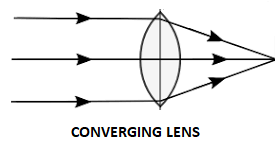
Thus, a small bulb is placed near the converging lens, and the bulb is switched on, which produces the parallel beam of light.
Hence, the option (C) is the correct answer.
Note: If the lens is very thicker at the centre than the both edges of the lens, then it is a converging lens or convex lens. And it is also called a positive lens because it is having a positive focal length. If the lens is thin at the centre than the both edges of the lens, then it is a diverging lens or concave lens. And it is also called a negative lens because it is having negative focal length.
Complete step by step solution:
Converging lens:
Converging lens is a lens which is used for transmitting the light to the focus area. The converging lens is also known as convex lens. This lens is thicker at the centre of the lens than the edge of the lens. The function of the convex lens is, when the parallel rays of light are allowed to pass through the lens, the refracted rays converge which means the refracted light rays will meet in the same point, that point is called the principal focus point. And the function of the converging lens or convex lens is reversed also. For example, when the bulb is placed near the convex lens or converging lens, it will refract the light rays, and the refracted light rays are parallel to each other.
Thus, a small bulb is placed near the converging lens, and the bulb is switched on, which produces the parallel beam of light.
Hence, the option (C) is the correct answer.
Note: If the lens is very thicker at the centre than the both edges of the lens, then it is a converging lens or convex lens. And it is also called a positive lens because it is having a positive focal length. If the lens is thin at the centre than the both edges of the lens, then it is a diverging lens or concave lens. And it is also called a negative lens because it is having negative focal length.
Recently Updated Pages
JEE Main 2023 April 6 Shift 1 Question Paper with Answer Key

JEE Main 2023 April 6 Shift 2 Question Paper with Answer Key
JEE Main 2023 (January 31 Evening Shift) Question Paper with Solutions [PDF]
JEE Main 2023 January 30 Shift 2 Question Paper with Answer Key
JEE Main 2023 January 25 Shift 1 Question Paper with Answer Key
JEE Main 2023 January 24 Shift 2 Question Paper with Answer Key
Trending doubts
JEE Main 2026: Session 2 Registration Open, City Intimation Slip, Exam Dates, Syllabus & Eligibility
JEE Main 2026 Application Login: Direct Link, Registration, Form Fill, and Steps
JEE Main Marking Scheme 2026- Paper-Wise Marks Distribution and Negative Marking Details
Understanding the Angle of Deviation in a Prism
Hybridisation in Chemistry – Concept, Types & Applications
How to Convert a Galvanometer into an Ammeter or Voltmeter
Other Pages
JEE Advanced Marks vs Ranks 2025: Understanding Category-wise Qualifying Marks and Previous Year Cut-offs
Dual Nature of Radiation and Matter Class 12 Physics Chapter 11 CBSE Notes - 2025-26
Understanding Uniform Acceleration in Physics
Understanding the Electric Field of a Uniformly Charged Ring
JEE Advanced Weightage 2025 Chapter-Wise for Physics, Maths and Chemistry
Derivation of Equation of Trajectory Explained for Students